Sep 30, 2024 BLOG
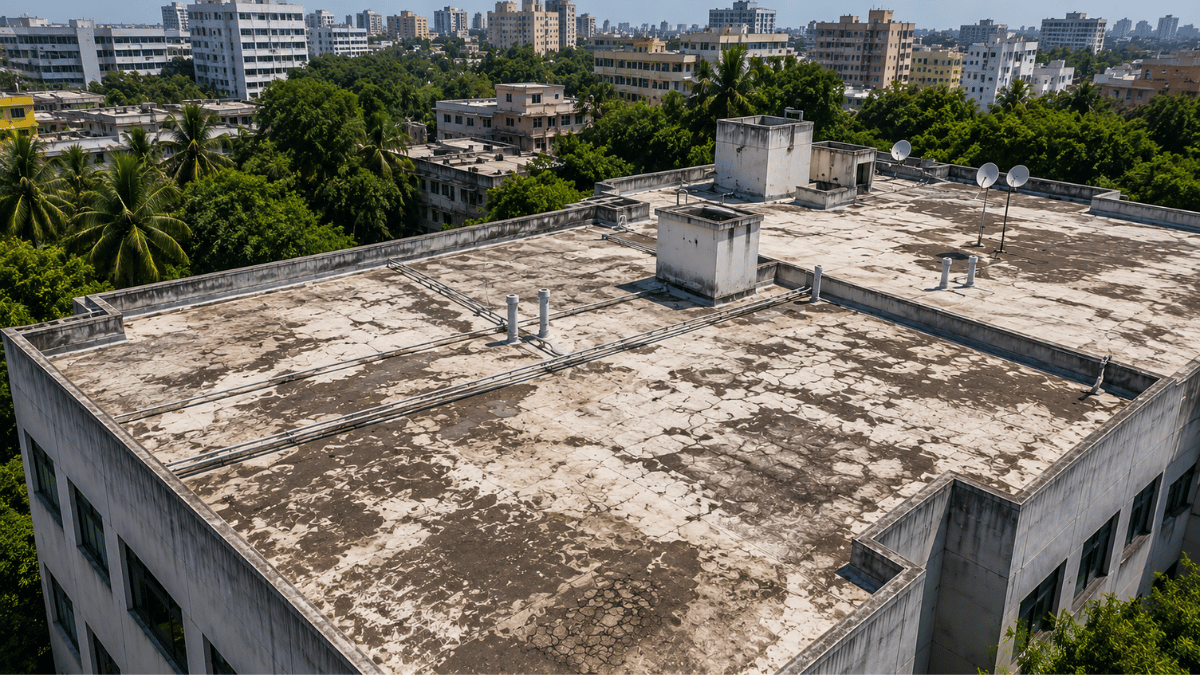
A damaged roof can hide problems that are difficult to identify from the ground. Cracks, water accumulation, deteriorating materials, and heat anomalies may go unnoticed until they become expensive structural issues.
Rooftop damage inspection using drones offers a safer and more accurate approach. Instead of relying entirely on ladders, scaffolding, or manual visual checks, drones capture detailed aerial imagery of the entire roof, including areas that are difficult or unsafe to access.
With high-resolution cameras, thermal sensors, photogrammetry, and advanced mapping workflows, drone roof inspection can provide detailed visual data that helps engineers, facility managers, and property owners identify potential problems and plan further investigation.
Rooftop damage inspection using drones involves deploying an unmanned aerial vehicle (UAV) equipped with specialized sensors to capture detailed information about a building’s roof.
The drone can systematically cover large or complex rooftops while maintaining a safe distance from the structure. The captured images can then be processed into detailed aerial datasets, orthomosaics, 3D models, or inspection reports.
Depending on the equipment and inspection objective, a drone-based inspection can help identify:
This makes drone roof damage assessment particularly useful for large commercial buildings, industrial facilities, warehouses, residential complexes, and other structures where conventional inspection can be time-consuming.
The value of drone-based roof inspection goes beyond simply taking aerial photographs. A structured drone survey can create a detailed visual record of the roof and its surrounding structures.
High-resolution imagery can reveal surface-level defects that may be difficult to observe from ground level. When combined with photogrammetry, these images can also be processed into measurable 2D and 3D datasets.
A typical workflow includes:
This approach makes roof damage assessment using drones more systematic, repeatable, and easier to document.
A drone roof inspection can do more than provide an aerial view. With the right sensors and processing techniques, drones can capture detailed information that helps inspection teams identify potential defects and prioritize areas requiring closer examination.
Identifying Roof Damage and Deterioration
High-resolution cameras can capture detailed imagery of roofing surfaces, making it easier to identify visible cracks, damaged tiles, loose materials, surface deterioration, and other abnormalities.
For large industrial and commercial roofs, this aerial coverage can significantly reduce the time required to visually inspect the entire area.
Inspecting Rooftop Equipment and Structures
Rooftops often contain HVAC units, solar panels, communication equipment, vents, and other installations. Drone inspection for buildings allows these components and their surrounding areas to be documented without requiring inspectors to physically access every location.
This can be particularly useful when equipment is installed across a large or difficult-to-access rooftop.
The biggest advantage of drone-based roof inspection is the ability to collect comprehensive aerial data while reducing the need for unnecessary physical access.
Key benefits include:
Rooftop damage inspection using drones is changing how building owners, facility managers, and inspection teams approach roof assessment. Faster coverage, improved accessibility, detailed imagery, and optional thermal and 3D data make drones a valuable tool for identifying potential issues before they develop into larger problems.
The key is not simply flying a drone over a roof, but collecting the right data and converting it into useful information. With proper flight planning, suitable sensors, and professional data processing, drone roof inspection can make rooftop assessment safer, more systematic, and more accurate.
1. What is rooftop damage inspection using drones?
It is the use of drones equipped with high-resolution cameras and other sensors to capture detailed aerial data of rooftops for identifying visible damage, deterioration, and areas requiring further inspection.
2. What can drones detect during a roof inspection?
Drones can help identify visible cracks, damaged roofing materials, surface deterioration, water accumulation, and abnormalities around rooftop equipment.
3. Can drones perform thermal roof inspections?
Yes. Thermal drone roof inspection can identify unusual temperature patterns and potential moisture-related or insulation anomalies that may not be visible in standard imagery.
4. Are drone roof inspections more accurate than manual inspections?
Drones provide comprehensive and repeatable aerial documentation, but they do not replace all physical inspections. The accuracy of the resulting data depends on equipment, flight planning, environmental conditions, and processing methods.
5. What types of buildings can benefit from drone roof inspection?
Industrial facilities, warehouses, commercial buildings, residential complexes, institutional structures, and other properties with large or difficult-to-access rooftops can benefit from drone-based inspection.